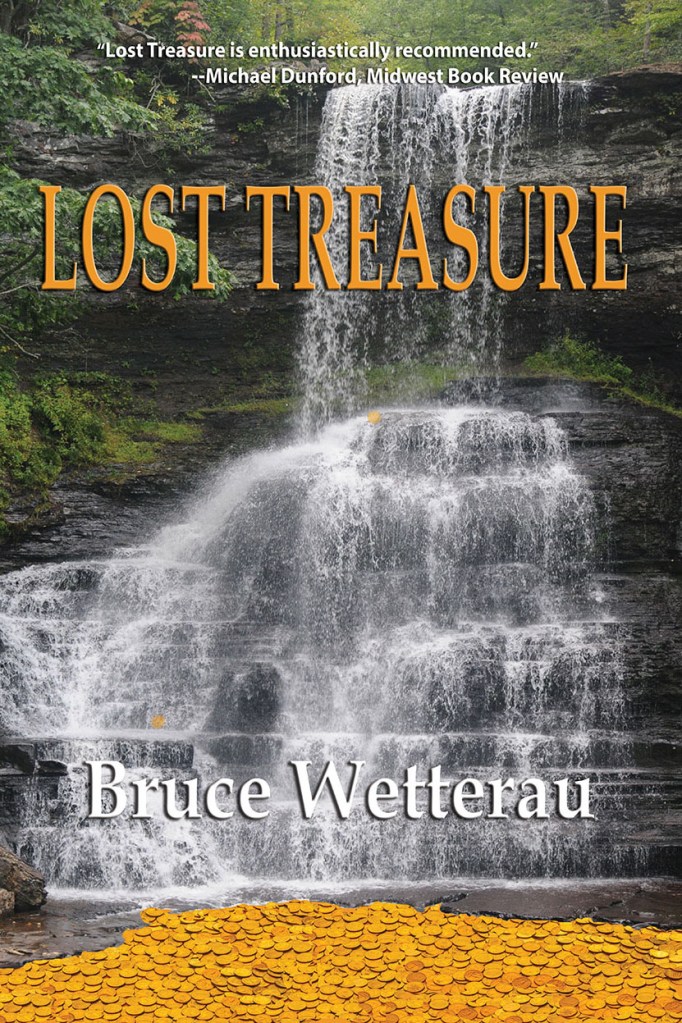
Inside the new book cover:
The same great story of Mystery, adventure, and A fortune in lost gold
"Lost Treasure is found gold."
--Rob Mason, software engineer
"One of the best adventure mysteries I've ever read."
--Bryan Bunch "science-history guy"
"An engrossing work of knife-edge suspense. Enthusiastically recommended...."
--Michael Dunford, Midwest Book Review
"Wetterau does a superb job in weaving fact with fiction...I look forward to reading future entries in this series, which is why I give this book 4 /5 stars."
--Jud Hanson, reviewer at Bestsellersworld.com
* * * *
THE BOOK COVER: Yes, Virginia Tech alums will recognize the waterfall pictured on the cover as Cascade Falls, a popular spot near the University. It's a beautiful setting, and a waterfall figures in the ending of the book, so I thought why not use it to refresh the cover of my first mystery. The pile of gold coins below the falls, of course, is a figment of my imagination that doubles down on the treasure hunt theme.
THE STORY: “You never know what you are going to find buried inside the walls of an old house.” Clay Cantrell has said that often enough, and he should know. After all, he and Mac Harper are in the business of restoring historic mansions to their former glory. But he never dreamed that a Confederate captain’s dusty old diary would send them on this exciting quest for a horde of lost treasure--Confederate gold that’s been hidden deep in a cavern somewhere in Virginia’s Allegheny Mountains. Sacks of rare gold coins worth millions today, just waiting to be found. If they’re still there.
Ex-Army Rangers, Clay and Mac are up for the risks they’ll have to take roaming the mountainous wilds, but finding the cavern won’t be easy. The diary gives only vague clues to its location and the secret Confederate supply depot inside. Their quest takes unexpected turns when Clay falls for the beautiful Susan Stratton and when he finds himself framed for a murder.
Lost Treasure alternates between the modern-day treasure hunt murder mystery and flashbacks to the Confederate captain’s harrowing story about the fate of the secret supply depot—and the gold--at war’s end.
What really happened in that cavern 160 years ago? Who is trying to frame Clay for a murder? Will Clay find the treasure at last?
Lost Treasure is the riveting first book in my Clay Cantrell Mystery series, now with three stand-alone mysteries in print and e-book formats. Each book features Clay and Mac entangled in a present-day mystery. Meanwhile flashbacks create a seemingly unrelated mystery in the past that somehow reaches forward in time to affect the case Clay and Mac are working.288 pages, trade paperback format, 6" X 9" trim size.
Still not sure? You can read an excerpt from the book. Just scroll down.
Also available through these fine retailers: Kobo, Apple, Baker & Taylor, Bibliotheca, BorrowBox, Everand, Gardiners, Hoopla, Odilo, Overdrive, Palace Marketplace, Tolino, Vivlio
In Roanoke, VA, at Book No Further, 112 Market St. SE.
excerpt from lost treasure
Chapter 1. The Lucky Day?

“Hey Clay, come here quick. You won't believe what I just found,” Mac Harper bellowed from deep inside the two-hundred-year-old mansion. You couldn't miss Mac's booming voice, even when he yelled from way down in the basement.
     The Clay on the receiving end of that bellow was 34-year-old Clay Cantrell, part owner of C&H Construction, a small outfit specializing, at least for now, in renovating and reselling old houses. At that moment Clay and his helper, Billy, were high up on a one-story addition to the mansion, tearing off the old, rotted roof deck. And in the process, sweating like pigs under a blazing afternoon sun. Clay straightened up at the sound of Mac's booming voice and yelled back, “What, Mac?”
     Clay, standing just over six feet tall, had the solid, broad-shouldered frame of a contractor who kept in shape by working right alongside his helpers. Never ask a man to do something you wouldn’t do yourself was a motto he lived by, and dressed for. He wore the standard, hot summer uniform of construction workers everywhere in the South--shorts, faded T-shirt, tool belt, sneakers, and baseball cap. His black baseball cap carried the Baltimore Orioles orange “O” logo.
     “You've just gotta see it, Clay. Take a break and com'on down here,” Mac bellowed back.
     “Probably the old man's private stash,” Billy chimed in mischievously.
     Clay grinned at the all-but-impossible image of the venerable Gen. Jacob Samuels, Ret., actually smoking pot. The general had been the last of a long, distinguished line of Samuelses to live on this old estate. By all accounts feisty to the very end, the old general probably would have bopped Billy with his cane for having said that.
     That was Billy though, an aging hippie with a lanky frame, tie-dyed T-shirts, and the ingrained irreverent, laid back attitude. He lived by the words “peace, man.” His beard was bushy and unkempt, and deep wrinkles already carved up his face, even though he was only in his mid-thirties. Billy, Clay knew, smoked a lot of pot, but he almost always showed up for work. For a common laborer in the contracting business, that practically made him employee of the month.
     “I doubt General Samuels even knew what a stash is, Billy,” Clay said finally, “but you never know what'll turn up in these old houses. One guy found $10,000 bucks closed up inside a wall.”  Billy's rutted face morphed into a wide-eyed, dropped-jaw look of surprise.
     Clay smiled, adjusted the baseball cap covering his jet black hair, and turned back to the roof deck, now about half finished. They still had work to do up there, but, he wondered, what if Mac's found something really valuable? Maybe one of those Samuelses back a hundred years ago didn't trust banks. Could it be cash? Or some jewelry tucked away in a secret spot? Yeah, jewelry would be good. Clay dropped his hammer into the loop on his tool belt and gave in to his curiosity.
     “Take a break, Billy, while I check out what Mac's found.”
     “Peace, man.”
     Clay could have gone down by way of the ladder leaning against the addition, but he liked walking the bare rafters. Sure, it was risky-- one slip and you could end up face down on the floor ten feet below--but the challenge only made it more fun. All you had to do was keep your focus and watch where you put your feet on the narrow, two-inch-wide rafter tops.
     Moments later he scrambled into an open second floor window, just above the point where the bare rafters tied into the main house. Inside, Clay barely noticed the scene of utter destruction. In the name of saving old houses, Clay and company tore plaster off walls and ceilings with abandon, ripped out old wiring and leaky plumbing, and tore up flooring apparently at a whim. A pitched battle might leave behind only slightly more destruction. But Clay knew this chaos as a necessary preliminary to the restoration work. You have to break eggs to make an omelet.
     Broken plaster crunched under Clay's shoes on his way through the upstairs bedrooms and then down a wide, curving staircase to a grand entrance hall, which in its day would have done Scarlett O'Hara proud. He continued on, striding through the cavernous dining room, past its tall windows and massive marble-faced fireplace. A right turn took him into what had been a servants' kitchen, now stripped down to bare studs, and then down the rickety basement steps. He made a beeline for the pool of light in the center of the darkened basement, where a couple of drop lights hung from pipes overhead.
     There, Mac Harper--the “H” in C&H Construction--and another helper named Nick were busy with Sawzalls--reciprocating saws--cutting out a snake's nest of pipes angling off in all directions from a big old iron boiler destined for the junk heap. Mac, brown-haired, big-boned and barrel-chested, was a size larger than Clay and every bit as big as his booming voice. He was the same age as Clay and, like him, in solid shape. But where Clay was beefy, Mac was all brawn.
     Coming up behind them, Clay yelled over the racket of the Sawzalls, “Hey! What'd you find Mac?”
     “Hah! Couldn't resist it, eh?” Putting down the saw, Mac pulled a dusty bundle from the top of the boiler. “You're going to love this. I found it up on the sill plate, pushed back where you'd never see it.”
     “This is it? I thought you’d found us some cash…or jewelry.”
     Clay knew he should have kept it to himself, but this didn't look like much of a find. Unfolding a dusty piece of coarse cloth, he found a leather bound diary, obviously very old, inside it.  The pale brown pages felt more like parchment than paper, and the elegant hand-writing had the curls and flourishes he’d expect to see in something very old. Might be worth something to a rare book collector, Clay thought, but he had no way of knowing how much. Turning back to the flyleaf, Clay read the handwritten inscription, Property of Capt. Chandler Burns, Supply Corps, 22nd Virginia, CSA.
     “A Civil War soldier's diary? Do you think it'll tell us who won?”
     “Yeah, yeah. Always the wise guy. Read those first couple of entries,” Mac prodded.
     Leaning into the light, Clay turned to the first entry, dated June 1, 1864, in which Capt. Burns told of arriving at his new command, a secret Confederate depot--a very unusual depot indeed--in the Allegheny Mountains to the west.
     “Check out the June 5th entry,” Mac said pointedly.
     Clay turned a couple of pages and started skimming. His eyes widened at the words strongboxes containing $34,000 in gold coins. Now we're getting somewhere, he thought. Capt. Burns had reported taking charge of a shipment of Confederate gold.
     Clay gave a low whistle as he closed the diary. “Cool. What are the odds it's still there?”
     Mac beamed. “Just what I wondered. And how much would that $34,000 in gold coins be worth today?”
     “A hell of a lot more than 34K, for sure,” he said laughing.
     “Hey, can I see it?” Nick asked anxiously. Nick seemed almost nervous, or maybe it was just the excitement of all that gold, but he avoided looking directly at Clay as he took hold of the diary.
      Nick had been working at C&H Construction for over a year now, mainly as Mac's helper. Blond haired with a buzz cut, Nick was in his twenties and about average build. Tats were his thing. His sleeveless T-shirt revealed entwined snakes on his forearms, fighting dragons on his shoulders, and barbed wire around his neck. Nick wasn’t the sharpest tool in the shed, but like Billy, he showed up and put in a day's work.
     Clay took the diary back from Nick. “Let me look at this tonight, Mac. Maybe it'll tell what happened to the gold. Might even lead us to a small fortune.”
     Might not too, Clay thought. He didn't want to be a killjoy by saying that out loud though. Mac obviously was wound up for a treasure hunt, and Clay liked the idea of that too--it could be fun, a real gas. He seriously doubted the Confederates had left the gold behind though. People just don't walk away from that much money.
     “Right now, Mac, we've got this pot of gold to work on. I'm going back up on the roof. Call me if you find any more treasure.”
     “That's my partner,” Mac complained playfully, “all work and no play.”
     It being Friday, Billy and Nick had already left by four o'clock, leaving Clay and Mac to close up for the weekend. Clay and Mac's identical burgundy Ford F-250 pickups--sporting C&H Construction logos--were now parked side-by-side in the cobblestone circular drive out front. Clay leaned casually with his back against his truck door, looking up at the old mansion.
     He liked its clean lines and impressive facade, dominated by four massive columns supporting the big gabled porch roof. The columns mimicked the stately hundred-year-old oak trees rising on either side of the house and dotting the fields out front. The house was big, the biggest total renovation they'd tackled so far, and in need of work from top to bottom. That was going to cost a lot, but the house had real potential if they found a buyer with deep pockets.
     He looked out over the rolling pastureland surrounding the mansion, located outside of Bell's Crossroads, a pimple of a town--maybe a dozen buildings--in Virginia's Shenandoah Valley.  It was a hell of a view, what with the Allegheny Mountains looming off to the west and a few scattered farms dotting the rolling foothills leading up to them.  Clay liked it out there at Fairview, the Samuels’s name for the estate. That awesome panorama never failed to take his breath away, yet it felt so tranquil and secure there, the imposing mansion standing solidly as an island of civilization against the landscape rolling out as far as the eye could see. That ambiance, Clay was sure, would help clinch a sale once they finished the renovation work.
     They had been lucky to find the place--Clay’s good luck, Mac had said. True, deals like this didn’t come along very often. But Clay couldn't forget how hard they'd had to work to finance the mansion and fifty acres, making it seem more like hard work rewarded than plain luck. Luck runs that way, sometimes.
     When Clay saw Mac come out and lock the front door, he picked up his tool bag and swung it into his truck bed. He slipped the old diary onto the dash and walked over to Mac, absently scratching an itch on the palm of his left hand.
     “Say Mac, I’ve been wanting to ask. Does Nick seem kind of edgy these days?”
     “No, not really. Why?”
     “Hard to tell. Lately it's like he's walking on eggs around me. How about with you?”
      Mac shook his head no. “Maybe he’s trying to screw up the courage to ask you for a raise.”
      “I guess….”
     Mac watched Clay scratching his palm again and began to smile. “You know what that itchy palm of yours means...”
     For a moment Clay looked as though he'd been caught with his hand in the cookie jar, then he grinned. Mac was the superstitious one so far as Clay was concerned. For his part he didn't want to put much stock in “the itch,” but in fact it seemed like they always did come into unexpected money whenever his palm itched.
     “...And that was the hand you used to put that diary into the truck!”
     “Easy big fella,” Clay said with a laugh. “I haven't even read the rest of the diary yet. And that itch was out to the side...Means the money's still a ways off.”
     “Then it'll come quicker if you get on it and read the damn diary.”
     “Okay, okay, Mac. Tonight. I promise I'll read it tonight.”
     “And call me about what you find out.”
     “Deal.” Clay hesitated a moment. “You know, Mac, the itch could be for the money we're going to make on Fairview. I mean it's going to cost us a bundle to get it up to speed, and the market isn't great right now, but these views are going to give us a real edge.”
     “Maybe you're right Clay...” Mac said, looking crestfallen. Then he brightened. “But it was the diary that made you itch, partner.”
     “Okay Mac, have it your way,” he said, giving Mac a friendly slap on the shoulder while they both laughed at Clay’s wordplay. Clay thought it best not to mention the sharp pain that came along with the itch in his palm. Mac would have known what that meant too, but Clay decided not to spoil his fun.

Staunton, where both Clay and Mac had been born and raised--and now lived--is an easy thirty minute drive almost due north of Bell's Crossroads. It's a small, picturesque city with a long history, where houses and businesses carpet the steep hills rising on the west side of the Shenandoah Valley. Home to a population of 20,000 plus, Staunton hasn’t lost its small town atmosphere. Most of the time it's quiet, the pace is slower, and traffic isn't a problem. And it’s just big enough that, unless you are of a mind to, you might never get to know anyone outside your own circle of friends. Or almost never see those you'd like to forget. Most people in Staunton don't mind that at all.
     For Clay's part, he lived in a place few people in Staunton even knew about, much less had been to--a secluded dell just within the city limits on the extreme north side of town. To get there, you left the paved road to follow a narrow dirt road snaking alongside a swath of rolling pastureland. After a minute the track turns to gravel, skirts an old mill pond lined with willow trees, and then dead ends up a short rise alongside the old mill itself. Nestled in the cleft of two hills rising on either side of it, the big four-story stone mill still has its big overshot water wheel in place, and though idled at the moment, it looks like a fully functioning antique. It is.
     That evening the sound of gently rushing water coming through the open window on this mercifully cool July evening should have had its usual calming effect on Clay's temperament, but it was not to be. The diary lay unopened on his desk in a fourth floor bedroom that served as his office. Instead, Clay's frustration arose from his accountant's printout of C&H Construction's accounts. Clay had been wrestling with their accounts receivable--money owed them--but it seemed like a losing battle.
     He rubbed his eyes. All of sixty days had slipped by since the Nicholsons had been billed and still no sign of the $35,000 final payment for an upscale addition to their Victorian home. He knew times were tough, but C&H Construction had racked up four jobs now with money still owed--$125,000 in past due accounts. Contracting wouldn't be so bad, he thought, if we didn't have to be the banker and collection agent too, along with salesman, builder, and grunt worker.
     That only made the other problem, a kind of vague feeling of being trapped and half suffocated, all the worse. In the five years since he and Mac had decided not to re-up for another hitch with the Rangers and started working together, they'd made a go of the business all right, but for Clay, and maybe Mac too, something was missing. No question the excitement of getting a new business up and running had disappeared long ago. Was he just getting bored with it now, he wondered.
     Tossing the printout aside, Clay reached for the leather bound diary, knowing he was probably grasping at straws. But, he thought hopefully, maybe something will come of it. Re-reading Capt. Burns’s first entry, he found the florid handwriting made for slow going, but he plowed through it, looking for clues to the treasure.

 June 1, 1864. My first command. Arrived today 3:30 p.m. at this godforsaken place, a hundred miles from anywhere, and farther still from the war. I despair of ever seeing action, of serving with honor, of avenging the injustices of this war upon those damned bloodthirsty Yankees. I should be leading men into battle, not scavenging food and clothing for them, or worse--this. Curse the fate that landed me in the supply corps, curse Capt. Morris for creating this vacancy by having died of typhus, and curse this place.
     Colonel Spencer told me this is a secret depot, and he need not lose any sleep on that account. Not only is it many mountainous miles into nowhere, but I very nearly didn't find my way here. I confess that I am unaccustomed to mountains, being from the flatter, more civilized lands about Richmond. Even so, the journey on the road west from Staunton took me to Stuarts Gap handily enough. But turning south to follow the Bullpasture River, the going became much less clear and much more arduous, the more so once I reached the confluence with Wilson's River.
     Turning northwest as directed at Jenkin’s River, I followed that tributary up into yet another range of steep mountains and was forced by the slopes to lead my horse rather than ride it much of the time. Worse, I could not tell which was the principal course of the river and which was yet another branch feeding it, requiring me to follow various dead ends and so straining my patience and my endurance equally. At last I came upon the distinctive, westward facing bluff--looking for all the world like a man's sloping forehead--that marked my journey's end. I knew with certainty that I had at last reached my goal by the idyllic waterfall, dropping some one hundred feet in three remarkably even stages, each as pretty as the last, which etches the bluff’s northern extremity.
     There, just across the stream curling along the base of that forehead rock lay my command, my curse, a yawning limestone cavern into which I then rode fully upright, following a beaten track sloping upward and lighted by lanterns, fully 200 yards into the bowels of the earth. Thereupon the wide tunnel opened up into a great cavern buried in the mountainside, an arena easily 300 ft. across with a domed ceiling thirty feet high. I could imagine it as it once was, naturally pitch black and clothed in stony silence. But here my garrison of a lieutenant and sixteen men had lighted this campsite with scores of lanterns and a cook fire, their echoing voices mingled with the wheezes, grunts, and stamping feet of their horses, stabled along the cavern's right wall. Directly ahead of me were rows of white tents, pitched I suppose more out of habit than necessity, and my headquarters tent, larger than the rest, stood well apart on my left.
    I found Lt. Ethridge, and formally, as formally as one could in a cave, took command of Depot No. 21. We are not soldiers here. We are moles with nothing to do. We don't even have to dig. There are tunnels leading off in every direction here, some to smaller caverns and others to impossibly narrow, craggy passages to God knows where.

June 3. My dear friend Capt. Barlow would have a hearty laugh over my fate, my exile to this godforsaken hole in the ground. He, who from the earliest years of our war, has had the honor of leading men into battle, could not help but suffer me with his laughter, if he could but see this pathetic command of which I now have charge. Finally, after years of importuning my superiors for the opportunity to do my duty, to join the battle against the hated Yankees, to serve our cause with honor, with what do they reward me?
     This cave, this so-called depot, long ago lost its military relevance. Where once it might have supplied our front lines in the Allegheny Mountains against an assault by Union armies from West Virginia, the battles of importance now concentrate far east of here in the Shenandoah Valley and about Richmond. The supplies cached in the catacombs under my command--stripped I suppose by earlier requisitions and never replaced--have been reduced in the main to those of little military value to us now. A miscellany really, hundreds of canteens, some wooden crates of old smoothbore muskets, harnesses and other tack but not the wagons to hitch them to, a hundred ramrods, but not a canon within fifty miles. I could go on, but it pains me too deeply.
     The men under my command, with but few exceptions, are as lax and undisciplined as any I’ve encountered. Blame the lack of purpose, I suppose, but I cannot abide by any man who has forgotten his duty to our honored cause. I fear that should the Yankees ever find their way to this infernal place, these men would simply throw down their arms and refuse to fight.
     They may curse my hide, but I will show them what it is to be a soldier, to do their duty. We will drill day in and day out and I shall punish the laggards harshly. These men shall be a credit to our noble cause, or I shall die trying.

June 5.  Orders, three keys, and disheartening news arrived by courier late tonight. The Yankees have attacked our army at Piedmont and in the rout, Gen. Jones was killed. Gen. Vaughn is falling back to Waynesboro, leaving Staunton--dear Staunton, the last outpost of civilization on the way to this godforsaken place--to be occupied by the Yankees as early as tomorrow. Expecting the Yankees to pillage and burn Staunton, Colonel Lee, the militia commander, has loaded much of the vast stores of military supplies and materiel cached in Staunton aboard Central Railroad cars for transit eastward, and also has sent a wagon train loaded with other supplies and evacuees south toward Lynchburg.
     Col. Spencer has ordered me to detach six heavily armed men in civilian clothes to drive two wagons with important cargo back here by tomorrow late or the day after. The wagons will carry full loads of furniture from some of the finest houses about Staunton, on the one hand to preserve these possessions of certain favored citizens (I am told they importuned Col. Lee in the most determined manner) from the expected ravages of the infidel Yankees, but more importantly to cover in the most surreptitious way three strongboxes containing $34,000 in gold coin, I suppose, precious reserves for our noble cause. What a clever ruse. Furniture to hide the gold, so no one will suspect we are moving such valuable cargo. Valuable to be sure--hard currency is essential for procuring supplies abroad. But how I wish they had included a few bags of coffee beans! I've been informed we've had none here for several weeks now.

June 8.  Our wagons arrived today by way of a little known track leading south from Monterey, the long way around. How they made it, I'll never know, but desperate times call for desperate measures.
     Last night, Lt. Ethridge supervised the construction of a keep for the gold, affixing a solid oak door with an iron bolt and padlock to close off a small side chamber in the rock near the rear of my tent. When the three metal strongboxes arrived today, I had them brought to my tent, so that Lt. Ethridge and I might inventory the contents and confirm their safe arrival for Col. Spencer.
     I am glad of the heavy padlocks on those strongboxes. Corp. Mullens, my orderly, drew an excited crowd as he brought the boxes into my tent. Alas, gold is a secret that cannot be kept close enough. And I gained no comfort from the lusty expression which crossed Mullens's weaselly face when we opened the strongboxes and emptied one of the leather sacks onto my table, exposing a small pile of the gleaming yellow coins to the light of day. Greed worthy of Midas himself shone in his eyes. When I let him hold one of the coins, he fondled it with a passion that disturbed me sufficiently to remove him from any further duties regarding the gold.
     Relieved of his presence, Ethridge and I proceeded to inventory the sacks of gold and return them to the strongboxes. I must confess that I felt the pull of that precious stuff each time we emptied a leather sack onto my table for counting. Hundreds of dollars at a throw spilled out before me--it was hard not to imagine all that the yellow discs, sparkling in the candlelight, could buy. I must confess, though, I haven’t seen the likes of these odd coins before. The curious, octagonal, fifty dollar pieces drew my attention first. I plucked one from the pile. It felt heavy, valuable, in the palm of my hand, and immediately I saw it had a plain flat back with no writing on it. The front bore the image of an eagle with outstretched wings and strange markings around the outside edge, to wit, “U.S. Assay Office, San Francisco, California.” Ethridge suspects from the date, 1852, that these coins have some connection to the California gold rush. The twenty dollar pieces are round, but likewise flat on the back. The U.S. Assay Office marking is stamped on the back with the date, 1853.
     Strange. I cannot imagine how this horde wound up in our hands, nor what purpose it may someday have. But the coins are all of the same dates and so shiny new that this may be only the first they have found their way outside the safety of a bank vault. The mystery of this horde, I fear, only redoubles the temptation it inspires. I can't speak for Ethridge, but for myself that only strengthened my resolve to do my duty and protect it at all costs. Col. Spencer has honored me by entrusting the gold to me for safekeeping.
     At the end of our labors we found all present and accounted for--$19,000 in the fifty dollar pieces and $15,000 in twenties. As I write, the cache is locked in the strongboxes and stowed safely inside the keep. The keys shall remain in my possession at all times and as an added measure of safety, I've posted a guard on the keep as well.
    The Yankees, we learned today, have flooded into Staunton, thousands of them under General Hunter's command. They have begun pillaging the military stores and burning any buildings connected with our war effort. Pitiful ruin of Staunton--where are our troops? Why doesn't Gen. Lee send reinforcements?

So what happened to you Capt. Burns, Clay wondered as put down the diary. What about all that gold? That thirty-four thousand has got to be worth a fortune today. That would sure take care of our cash flow problems--with a bunch left over. Now that’s a really tempting thought, not very practical, but tempting all the same.
     Do we really have a shot at finding it? Capt. Burns gives a pretty clear set of landmarks that, with a little luck, could help us find the cave. And the gold did arrive near war’s end, when anything could have happened. Will the diary tell us the rest of the story?
     With that thought, Clay leafed past a couple more entries on Burns' first days, including his casual exploration of some tunnels running out from their encampment. Then Clay ran smack into a brick wall. Without explanation, Capt. Burns suddenly began writing entries with words Clay couldn’t understand, and kept on all the way to the dairy’s last entry.
     It’s not code, Clay decided, and he guessed it was probably French, which might just as well have been code for him. He read, and then re-read the preceding entry, but Capt. Burns gave no hint why he switched languages.
     Left with just the thought of all that gold teasing his imagination, he wondered again how many times the $34,000 the horde would be worth today. It would have to be huge, the way the price of gold has been skyrocketing. But how in the world could that much gold have gotten left behind? And if it had, why hasn't it been found by now?
     He looked at the diary again. The answer had to be right there in front of him--if he could get the diary translated. There was a way, Clay thought, but he’d have to talk about it with Mac. He looked at his watch. Eight-thirty. He’d call Mac and then it was time to head into town for a few beers.
     Later, Clay settled into the last open seat at the Ratskeller, a local bar in a renovated warehouse basement, done up with lots of dark rustic wood. Clay’s regular hangout, the place boasted a casual atmosphere, microbrewed beer on tap, and a reputation for serving up good food. Clay smiled at the twins, two slim brunettes, sisters who'd been tending bar there for as long as he could remember. Most people at the bar couldn't tell one from the other, but Clay had figured out the difference long ago. A pint of Vienna lager appeared in front of him, without his asking. It helps to be a regular.
     “Thanks Angela,” Clay said and took the first couple of swallows, thoroughly enjoying the cool, rich taste of the craft brewed lager.
     “How can you tell which one she is?” the man sitting next to him asked Clay.
     “Lots of positive reinforcement,” Clay answered almost without hesitating. He took another swallow before looking over at the man. “Mr. Perry, I didn't realize it was you. Sort of intent on the beer, I guess.”
     Jason Perry, now a captain in the Staunton-Augusta Fire Department, smiled and shook Clay's hand with genuine gusto, practically grabbed it. The father of Clay's friend Jason Jr., Mr. Perry had brown hair freshly clipped in a crew cut and sported a neatly trimmed salt and pepper mustache. His short-sleeved white dress shirt, now at day’s end, still looked freshly pressed and creased even at this late hour. A large man, tanned and once obviously very fit, Mr. Perry himself was not doing quite as well as his shirt. The years and added pounds were taking their toll, but he hadn’t yet lost his youthful vigor.
     Though Clay ran into Jason Jr. from time to time, he hadn't seen Mr. Perry since leaving the Army. For his part, Mr. Perry obviously had had a couple of beers and wanted to talk.
     “Jason Jr. told me you were back, Clay. Said you're a contractor now, working here in town.”
     “Yes sir, Mac Harper and I started a company, C&H Construc-tion.” Clay continued working on his beer. That first one always went down so easily.
     “Doing okay?”
     “Not bad, considering where the market is right now. We're working a niche market. Pretty much just old house renovation and remodeling.”
     “Good. I like seeing guys who served their country come back and be successful. Kind of confirms my belief in the ole Stars and Stripes. Can I buy you another one?” he asked, pointing at Clay’s now empty glass.
     “Yes sir. Thanks.”
     “Angela, another round here when you get a chance.”
     “Uh, that's Abbie, Mr. Perry,” Clay said with a grin.
     “Oh well, they must be used to it. I don't get here often enough, I guess.” Two fresh pints appeared on the bar before them.
     “Shouldn't that be a Bud?”
     “I drank plenty of that in my youth,” Clay said with a grin. “When I was stationed in Germany, I got a taste for craft beers. More flavor, and a little more kick too.”
     “You were in the Army, weren't you? Iraq?” Mr. Perry asked after a moment.
     “Iraq and Afghanistan, the Rangers.”
     “I was Army too. Vietnam. You young guys have it good now. We came back from Vietnam and everybody hated us. You fought for Uncle Sam, risked your neck out there in those stinkin' jungles, and if you got back alive, all you could do was shut up and pretend you'd never been a soldier.”
     “Definitely a different war. Did you see a lot of action, Mr. Perry?”
     “Jason, Clay. You can call me Jason. Yeah, it was different all right. I did two tours over there. Knew a lot of guys who didn't want to be there, but I did.” He took a drink of his beer and seemed lost in the memories for a moment. “We'd be on patrol for a week, sometimes two weeks out there in that stinkin' jungle hunting VC, watching out for their damn booby traps and looking for any sign they were around. We were sitting ducks, miles away from base. You had to be on, hyped up and ready for anything the whole time you were out there.
     “Heh, then we'd get back to base, and some punk staff officer would stick us on bunker duty, standing watch nights on the base perimeter. You know, we'd just been hangin' it all out there for a week, while these guys had been sittin' pretty behind barbed wire, Claymores, and all kinds of firepower. Kind of made you a little resentful.
     “Well, once in a while, just for the fun of it, one of us would yell ‘Gooks in the wire!’ and start blasting away at nothing, like we were under attack. All hell would break loose, M-60 machine guns blazing away, foogas barrels popping off and spraying the jungle with fire, Claymore mines exploding and blowing big holes in the wire. Made a hell of a mess, but man, what a show. All for the fun of it.”
     “Foogas, I’ve heard about that. Fifty-five gallon drums loaded with some kind of sticky version of napalm, right?”
     “Yeah, nasty stuff. The drums were half planted in the ground with C-4 under them and pointing out toward the jungle at the base perimeter.  The C-4 goes off with a bang and throws a shitload of that burning jelly out into the jungle. Flames and smoke everywhere. Sure gave Charlie something to think about.” Mr. Perry fell silent for a moment, as if remembering the time.
     “You're settled back in civilian life now, Clay,” he said finally. “Do you ever miss the action? I mean, sure, you're risking your life--a firefight could break out anytime night or day--and I lost buddies over there. Guys that didn't deserve to get it.
     “But the combat, I'd be all keyed up, pumping adrenaline and blasting away, blowing shit up. The bang-bang stuff was a real thrill. I’ve never felt so alive as I did over there. Probably why I joined the fire department. Fires make for dangerous work, but it's a chance to feel jazzed up, even if it's only for a little while.”
     “I know just what you're saying” Clay said. “Nothing like having somebody shooting at you to get your attention. When I first got out, I guess I just got wrapped up in all stuff I had to do, getting the business off the ground and all. But now....”
      Mr. Perry smiled knowingly. “You never really forget that excitement, I think. But I'm rattling on here. Think I'd better call a cab. Wouldn't do for a deputy chief to get nailed for a DUI. That's one thrill I can live without.
     “Abbie, could you call me a cab?”
     “That's Angela, Jason.”
     “Jeez. How can you tell?”
     “She's the one with a big mole on the inside of her thigh,” Clay said with a deadpan look.
     “Big help that is, she's got long pants on. How do you know....?” Jason caught himself and started laughing. “In some ways Clay, you haven't changed a bit.”
     Clay ordered another beer after Jason left by cab, nursing his drink for another half hour while he again thought about the treasure. Even if it wasn't there, he decided, it'd be a kick just trying to find it. And maybe tomorrow they'd get some answers about translating the French, or whatever it was. Then they'd really have something to go on.
     Downing the last of his beer, Clay settled up and walked out into the parking lot. He'd just reached his car when he heard the yelling and a girl scream on the other side of the lot. He spotted a man holding onto a woman by her forearm. She screamed “Let me go,” and desperately tried to wriggle free. Suddenly the man swung her hard by the arm and slammed her like a rag doll into the side of his car. She hit with a loud bang and fell to the ground hard.
     “Get in the car, now bitch!” he screamed at her and jerked her arm up.
     Clay bellowed “Hey!” loud enough that it echoed off the building next to the parking lot. As the man looked his way, Clay pointed and yelled, “Let go of her!”
     “Screw you! Whaddyah think you're going to do about it, ass-hole?”
     That got his attention, Clay thought as he started walking calmly but determinedly toward the man. He looked calm, but inside he could feel the adrenaline rush and the sudden heightened awareness. Good thing. The closer he got, the bigger the guy looked. Same height, but he had maybe thirty pounds on Clay. A lot of it bulked up chest and shoulders. Probably a weight lifter, Clay guessed.
     “I said let her go,” Clay ordered with authority, and volume. He was angry, but kept in check that was a weapon he knew well. He just kept walking calmly toward the man, who still held the sobbing woman's forearm. Good, Clay thought, one hand occupied, the other just a bare fist.
   “Back off shithead before you get hurt.”
   Clay kept walking directly toward him and locked eyes with him as he closed the gap. “Let her go.” As he said it, he stepped right up to the man, almost right in his face, and growled, “Now!”
   Whatever the man was about to say changed to a howling cry of pain the instant Clay's knee in the groin landed full force. As the man doubled over in agony, Clay loosed a hard right uppercut that threw the man up against the car. The man’s suddenly limp body shuddered before sinking to the ground. Out cold.
     Clay just stood there for a moment, breathing hard and almost hoping the man would get up again. The woman's shaky voice brought him back to reality.
     “Thanks mister. I don't know what would have happened if you hadn't shown up.”
     “That's okay. Glad to help.” He took her hand and pulled her up onto her feet. “Who was that guy? Not your husband I hope.”
     “Husband? Thank God no. I met him in the bar. He seemed nice enough and said he was just going to walk me to my car. Then he grabbed me and dragged me over here. He hit me....”
     She started sobbing again. Clay put his arm around her.
     “Hey, it's going to be okay. I’ll call the police. They’ll deal with him.”
     “No! No police. If this gets back to my father….he’ll kill him.”
     “Let me call you a cab then. You're in no shape to drive.”
     “No. Thanks, I'll be all right. I just want to get out of here before he wakes up.”
     She did, but just barely. The guy had just begun stirring when she pulled out. Clay leaned casually against a parked car, watching the man struggle back to consciousness and then to his feet. For his part, Clay hadn't felt this alive in a long time.
     The man practically groaned the question, “What the hell did you hit me with?”
     Clay ignored the question. “You're damn lucky she didn't want to press charges. If I ever see you treat a woman like that again, they're going to be carting you off to the hospital. Understand?”
     The guy nodded and slowly, very slowly got into his car and drove off. Clay's right hand was just beginning to feel sore, but he barely noticed it.
 My Mystery Time -- Mysteries and More by Bruce Wetterau